Table of contents
Table of Contents
Text styles
H1
H2
H3
This is the Paragraph text and it’s style. Ultra ensures that a robust plan is in place and drives the project towards an efficient and effective execution of the plan. We provide the templates, know the systems and vendors and have a deep understanding of process best practices. Therefore, we typically save our clients over a month from selection through implementation and an average of $160,000 over the lifecycle of the ERP solution.
This is the Paragraph text and it’s style bolded.
This is the Paragraph text and its style is bolded and italicized.
Top sections
What does an ERP consultant do?
And is it worth the cost to hire a consultant?
A closer look at the numbers and how to choose
a good ERP Consultant
We bring over 25 years of experience consulting for private equity firms to maximize their portfolio returns.
Accelerate portfolio company value through business process improvement
When initiating a digital transformation for a company in your portfolio, making Business Process Improvement an integral part of the digital transformation process ensures maximum ROI. We guide our clients along the discovery of best practices and best technology to arrive at the best fit enterprise solution for their unique complexities.
We manage, educate, and guide our clients through the ERP selection process, creating greater value through an on-time and on-budget implementation. The result? A thorough digital transformation that leads with best practices and best-fit technology solutions.
Icon and information sections
An ERP Consultant is an expert who assists organizations in:

Managing the ERP project

Revealing opportunities for BPI

Selecting an ERP system

Negotiating the contract

Implementing the software

Training the stakeholders

Evaluating the results

Ensuring value realization
Contact Our Team

Experience & Expertise
Two of our seasoned veterans with expertise in process improvement demonstrate how to focus on improved business performance–not solely technology–in our ebook A Better Foundation for Your Digital Transformation.

You’ll Learn
• The three questions you need to ask of your business before starting a digital transformation
• The 11 core processes that optimize value creation
• The key to changing processes effectively…and more.

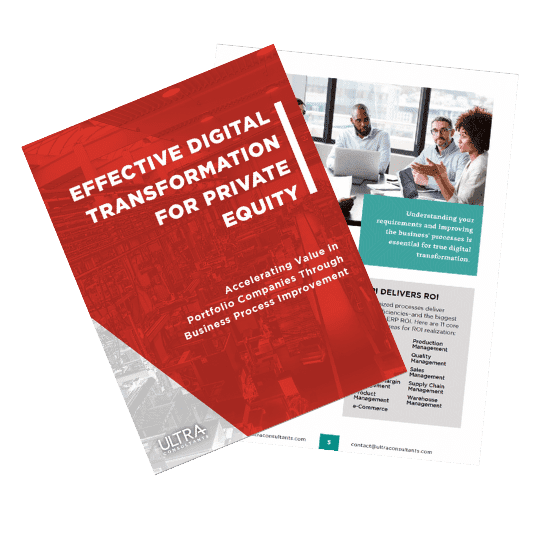
Private Equity-Focused Ebook
Download our new Private Equity-focused ebook outlining successful digital transformation strategies for PE Portfolio Companies.

1
Have a well-defined project plan.
2
Appoint a dedicated implementation team
3
Encourage strong communication with open dialogue
4
Manage realistic expectations, timelines, and milestones
Average Implementation Times by Organization Size
Small Businesses: 3-4 months
Medium-sized Businesses: 6-9 months
Large businesses: 9-18 months
Multinational Businesses: 12-36 months
Q. How Can A Company Shorten the ERP Implementation Timeframe?
From the question, “How long does it take to implement?” you should ask, “How can we decrease that number?” An effective plan can shorten the ERP implementation timeline, reducing risk and accelerating time to value. Consider the following factors to decrease the time it takes to implement a new ERP system.
Define Business Requirements
Start by identifying the specific business needs that the ERP system should address, including all existing business processes. This helps to ensure the implementation will align with the organization’s goals.
Conduct a Feasibility Study
Evaluate the organization’s current systems, processes, and infrastructure to determine the feasibility of the ERP implementation.
Choose a Vendor
Select a vendor that has experience in implementing ERP systems or works with an implementation partner for organizations similar to yours.
Create a Project Plan
Develop a comprehensive project plan that includes timeline, budget, resources, and responsibilities.
Assign a Project Team
Communicate with Stakeholders
Communicate the project goals and progress regularly with stakeholders, including employees, customers, and vendors.
Test and Validate
Plan for Training and Support
Develop an end user training program for employees to ensure they are equipped with the knowledge and skills needed to use the ERP system effectively.
How long does it take to implement an ERP?
The length of time for an ERP (Enterprise Resource Planning) implementation varies depending on several factors, including the complexity of the organization’s processes, the difficulty of the data migration, the size of the organization, the number of modules to be implemented, and the level of customization required.
Typically, an ERP implementation project can take anywhere from several months to a year or more. Smaller organizations with simpler processes and a limited number of modules can implement an ERP system in as little as three to six months. Larger organizations with complex processes and multiple modules can take up to 18 months or longer to implement an ERP system.
It’s important to keep in mind that ERP implementations are complex projects that require careful planning and execution from all ERP project team members. Taking the time to properly plan and prepare for the implementation can help ensure a smoother and more successful project outcome.
Consider Using Experts
To speak with a knowledgeable ERP and digital transformations specialist about the complexities of your business and how best to select an ERP system or begin the ERP research and analysis processes, reach out to us. With new software and new processes, the future possibilities for your business are endless. And after your ERP selection, we’ll stick around to manage your successful ERP implementation process for you as well.
Keys to A Successful Implementation
The implementation of ERP software is a massive, time- and resource-consuming project that is best handled by a project management professional, ideally someone who has extensive knowledge and experience implementing company-wide software initiatives. If you have such a person at your company, they won’t need the following information. But if you don’t, you may find the information helpful. how long does erp implementation take
The six stages that we utilize when managing an implementation project are:
Callout Sections
What makes a great ERP Consultant? They save time, resources and costs.
Cost Overruns
Implementing an ERP system can be expensive and may require additional funding, leading to cost overruns and budget constraints.
These complexities highlight the importance of careful planning and execution during ERP implementation, to ensure the project is successful and delivers the intended benefits to the organization.
Technical Challenges
Technical issues such as compatibility, scalability, and performance can arise during implementation and negatively impact the typical ERP implementation plan.
How should organizations prepare for an ERP Implementation?
People – These are your greatest assets. Loop in your key stakeholders.
Processes – Document every process and think through efficiencies.
Technology – Make an inventory of current technology to see if it is optimally utilized.
Text sections
SAVES TIME–because employees don’t waste time trying to figure out next steps.
An internal project manager is typically inexperienced in company-wide initiatives, which puts the entire project at risk.With an experienced Project Manager at the helm, companies aren’t left in reactionary mode, letting vendors dictate the process and guessing at what process works best to evaluate vendors and custom solutions. A consultant with dozens of ERP projects under their belt knows the best path forward, knows the issues to watch for and which factors can accelerate the process when done correctly.
Don’t let your organization attempt these projects alone.
The length of time for an ERP (Enterprise Resource Planning) implementation varies depending on several factors, including the complexity of the organization’s processes, the difficulty of the data migration, the size of the organization, the number of modules to be implemented, and the level of customization required.
Typically, an ERP implementation project can take anywhere from several months to a year or more. Smaller organizations with simpler processes and a limited number of modules can implement an ERP system in as little as three to six months. Larger organizations with complex processes and multiple modules can take up to 18 months or longer to implement an ERP system.
It’s important to keep in mind that ERP implementations are complex projects that require careful planning and execution from all ERP project team members. Taking the time to properly plan and prepare for the implementation can help ensure a smoother and more successful project outcome.
1. Try ERP implementation project planning on their own
2. Hire an implementation partner recommended by the ERP vendor
3. Have an ERP projects independent consultant advise and manage the ERP implementation phases (sometimes involving an implementation firm as well)
- Project planning
- System design
- ERP Software configuration
- Data migration
- Testing
- User Training
- Deployment
Call to actions
Are you ready to see what an ERP consultant can do for your organization?
Call or set up a free 30 minute consultation with one of our ERP experts today!
Ready to see how our experts can bring value to your digital transformation project? Schedule a free 30-minute consultation today and discover how Ultra Consultants assists hundreds of companies to accelerate their business growth!
Download our new Private Equity-focused ebook outlining successful digital transformation strategies for PE Portfolio Companies.

Proven strategies to
stay in control of the selection process
Watch our explainer video
Proven strategies to
stay in control of the selection process
Watch our explainer video
Here are some popular resources for private equity.
Driving Real Value in Private Equity: An Interview with Ernie Eichenbaum of Ultra Consultants
Private equity firms are under growing pressure to deliver measurable, lasting value—not just cosmetic improvements. In this exclusive interview, Ernie Eichenbaum of Ultra Consultants shares…

Technology Alignment in M&A
Mergers and acquisitions (M&A) are complex and not just due to financials, legal compliance and market positioning. More and more, getting technology alignment right proves…

Digital Transformation Trends, Challenges, and Opportunities
Today’s world is a connected one—and digital transformation isn’t optional; it’s something businesses need to survive and thrive. Industries like utilities, manufacturing, distribution and private…

EVANS
BPI Sets Stage for Success
Evans Food Group, Ltd. was experiencing growth and had tried to solve the company’s growth challenges through ERP before.

PACIFIC PLUMBING SUPPLY CO.
Distribution Expertise Enables Success
Pacific Plumbing Supply’s managers knew that an ERP implementation was going to be difficult with the redefinition and remaking of established processes and change at every level of the organization.

Deschutes Brewery
BPI Finds New Efficiencies
Learn how Ultra utilized business process improvement, new efficiencies and modern software to give Deschutes the capabilities it needed to open a new brewery in Roanoke, Va.
MICRO CONTROL
Focus on Eliminating Manual Processes
Micro Control had a big spreadsheet they used to manage its entire operation. The company needed a system to help them manage that planning and tracking, provide visibility and better track costs and work in process.

Digital Transformation: The Ultra Way

INDUSTRY EXPERTISE
Our people bring deep knowledge of the fundamentals, pain points and core processes of the manufacturing and distribution industries, as well as an understanding of the needs and nuances of your business. The result is specialized solutions that successfully and comprehensively address your specific requirements and aspirations.

SOFTWARE KNOWLEDGE
We focus exclusively on ERP and ERP-connected software solutions for the manufacturing and distribution industries. This concentration means our expert consultants, who understand the unique needs of your vertical and your business, also know which solutions will deliver the most benefit and greatest performance improvement for your organization.

CLIENT-CENTRIC
Our emphasis is on execution and outcome. We understand that time-to-value and return on investment are tremendously important to your company. We know that an on-time, on-budget, high-value solution requires our teams, strategies and solutions to be creative, efficient and flexible. And we believe that we must invest in your success.

UNIQUE METHODOLOGY
Our four-phase approach guides your company through the business transformation lifecycle. Business Process Improvement builds a foundation for your transformation. Enterprise Technology Selection determines the best-fit solution. Solution Implementation Management shortens time-to-benefit and reduces your risk. Business Value Realization maximizes return on investment and ensures your organization continues to get every benefit from your solution.
Why Choose Ultra Consultants?

100% independent
Because we don’t receive compensation from software vendors, you get recommendations based solely on your unique needs.

Industry focused
We put our decades of manufacturing and distribution focus to work for you.

Complete solution provider
Going beyond technology selection we guide your company toward business process improvement for long-term growth.

Experienced, in-house team
We hire top talent and invest in their development so your consultant has the knowledge to provide a successful technology project.