
Where’s the ROI in ERP?
Every manufacturer and distributor is different. And every company will get a different return on their investment (ROI) on their ERP investment.
Where will your organization find the payback period? Some areas are rich with opportunity.
On average, companies see a return of more than $7 for every dollar they spend on an ERP project.
– Nucleus Research
When an ERP project is considered, one of the first tasks is to determine the ROI your more efficient organization could realize with new technology and improved processes.
At the basic level, your ERP return will come most directly from more efficient production and resulting reductions in operating costs, inventory, and labor cost. But the benefits can be indirect, too.
Optimized processes streamline ordering, eliminate manual processes, improve production quality, and enable more efficient scheduling. Improved access to operational data offers more accurate materials planning, streamlined reporting, new dashboards, and better, data-supported decision-making. And there will be tangible benefits driven by increased customer satisfaction, enhanced supply chain communication, delivery performance, and more.
11 Core Areas for ROI Realization
Here’s why it’s important to determine ROI: It will provide the justification for your project. It will inform the software selection process. It will set up areas of focus and measurement – and give you the ability to determine whether your transformation process is a success.
When your organization sets out to make the business case for an upgraded or entirely new ERP system, the search for potential ROI starts with these 11 core process areas:
Financial Management
Management and the entire organization benefit significantly from increased confidence in financial results and analysis, accelerated information access, faster closing and period-end activities, and efficiencies driven by reduction (or elimination) of outside-the-system spreadsheets. These improvements support stronger cash flow, reduced accounts receivable cycles, and a measurable return on investment.
Forecasting
With the improved information and analysis that comes with robust Sales & Operations Planning (S&OP) capabilities, it’s possible to more accurately forecast demand, make more informed business decisions, to take advantage of trends and, most important, to be able to quickly, precisely and proactively manage changing sales demand, handle market changes, disruption and economic shifts, and more accurately plan production and resource capacity.
Inventory Management
Better visibility into sales demand and improved forecasting enable more accurate inventory management, lower carrying costs and improved visibility into slow-moving and dead inventory. These improvements directly impact working capital and improve your ERP ROI.
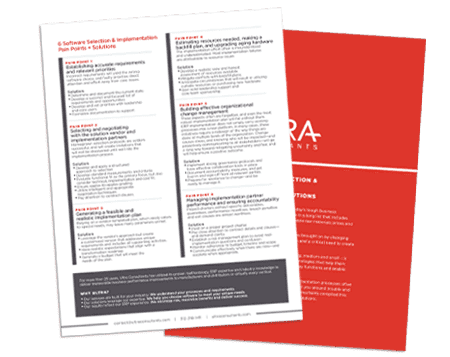
6 Software Selection & Implementation Pain Points + Solutions
Software selection and implementation processes often present challenges of their own. To steer you around trouble and help you drive success, Ultra’s experts compiled a list of pain points and solutions to be aware of as you embark on this journey.
Pricing and Margin Management
Powerful pricing tools enhance margin/profit analysis, which enables improved competitive positioning and, in combination with Product Lifecycle Management (PLM) analysis, offers information that can be used to more effectively manage product portfolio and drive higher revenue growth.
Product Development
PLM provide the ability to effectively manage product lineup and mix, and R&D investments, and identify products that no longer meet the company’s strategic objectives, supporting ERP benefits tied to innovation and lifecycle optimization.
Production Management
Better production management capabilities offer improved capacity planning, plus the opportunity to conduct detailed analysis of production bottlenecks, routing times and material movement, workforce utilization, plant and equipment utilization improvements, maintenance scheduling and machine uptime, all enabled by advanced ERP software functionality.
Quality Management
QM tools delivered greater visibility of product performance, as well as improved Return Material Authorization (RMA) root cause analysis, visibility into rework activities, and better information on raw materials quality, supplied component products and third-party services. This real-time access to quality data supports lower TCO and faster go-live benefits.
Sales Management
Customer Relationship Management (CRM) capabilities provide comprehensive sales performance analysis and deliver an important insight into customer buying patterns, customer demographic data, sales activities and sales performance. These insights can be measured via ROI metrics to validate your ERP implementation strategy.
Supply Chain Management
With improved inventory management, the entire supply chain can be managed better, delivering lower logistics costs, more effective supplier/vendor management (and higher performance), shorter lead times and data that can be used to support strategic sourcing and vendor negotiations, all helping you optimize your supply chain with the right ERP system.
Warehouse Management
Warehouse Management Systems (WMS) technologies improve speed and accuracy using high-efficiency managed pick-up/put-away, barcoding and routing. Whether on on-premise or cloud ERP system architecture, these capabilities reduce errors and minimize waste, supporting scalable operations and a lower total cost of ownership (TCO).
E-Commerce
Enabling direct-sales channels, or improving existing e-commerce efficiency and customer experience, offers a significant competitive advantage and cost savings. A robust e-commerce capability drives higher customer satisfaction, repeat buying, better forecasting and higher margins. And there will be efficiencies that come from re-organizing warehouse operations to support efficient pick-pack-ship especially in a less-than-case-order environment.
Quantifying the return in these areas – and others – is the next step, a significant challenge, and where an outside ERP advisor can help with industry benchmarks, experience with similar projects, and business process improvement expertise. Using an ERP ROI calculator can help identify implementation costs, upfront costs, subscription fees, and the full TCO—including upgrades, support, and long-term scalability. Whether you’re investing in an on-premise or cloud-based solution, aligning with your stakeholders and executing strong change management practices is essential to success. Get expert guidance on your ERP journey—schedule your free discovery call with Ultra Consultants today.
How can you improve the odds of ERP success?
Table of Contents
More ERP material...
Why Do Business Process Analysis Before a New ERP System
Learn why analyzing and improving processes upfront is critical to reducing risk,…
Systems Integration in Food Manufacturing: Less Waste, Better Efficiency
This post will examine why managing quality records outside of an ERP…
Generative AI in Manufacturing
This post will examine why managing quality records outside of an ERP…