"AI has the potential to be more transformative than electricity or fire." —Sundar Pichai, CEO of Google
"AI is going to reshape every industry and every job." —Reid Hoffman, Co-founder of LinkedIn
"AI will not replace humans, but those who use AI will replace those who don't." —Ginni Rometty, Former CEO of IBM
These are just a few quotes from business leaders on the potential of artificial intelligence (AI), as it moves out of sci-fimovies and into reality. And just as AI makes that shift, business leaders in nearly every industry are making the shift from questioning whether to adopt AI, to how to do it in a way that aligns with their business goals and generates the most value.
To make that happen, businesses need more than random AI tools or technicians. They need a strategic approach grounded in clear alignment with business objectives, supported by the foundation of a data-driven culture and organizational readiness.
2
What's inside.
3 Building the Foundation
5 Identifying AI Opportunities
6 Budget Planning
6 ROI Considerations
6 Change Management & Implementation
Conclusion 7 3
Building the Foundation
Successful completion of an AI initiative depends on more than just finding the right AI software. The first step toward success is taking a good look at the company's overall readiness, beginning with its IT infrastructure.
Digital Maturity
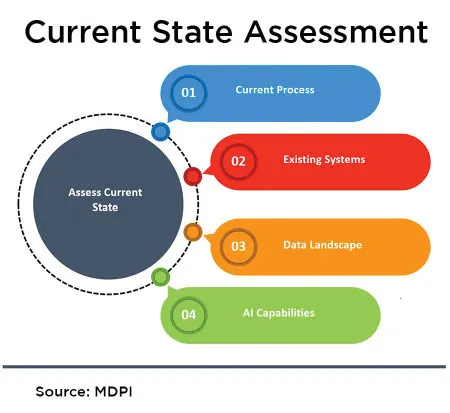
AI systems depend on IT infrastructure to support the kind of workloads AI will demand. From hardware and data storage to network and software stacks, it all contributes to AI performance.2
But unlike traditional IT systems, AI infrastructure needs to handle large amounts of data and real-time processing. Whether on-premises, cloud-based, or hybrid, these resources form the structural foundation that allows AI workloads to scale and perform efficiently.
But ensuring the company has the right AI infrastructure in place extends beyond buying new tech gear or computers. It needs to ensure that systems are in place to grow with the needs of the company as AI projects scale, handling the extra load without slowing down. Making sure everything is secure, works with older legacy systems and fits into how the company already operates requires careful planning and smart design.4
"AI infrastructure, also known as an AI stack, encompasses the combination of hardware and software specifically designed to support AI workloads, including machine learning and deep learning operations."
TMCnet
Use Cases Across Industries
Companies across a variety of industries are adopting AI-powered data management tools to address challenges specifi c to their sector, while helping to reveal opportunities for growth. Here are a few examples: 4
Data Governance and Data-Driven Culture
AI runs on data, so the next foundational step is to ensure that your company has clean, structured data with strong governance policies in place. A strong data governance policy helps ensure that data is accurate, secure and available. Companies must ensure the right data is accessible to AI tools when and where it's needed for effective analysis and smarter decision-making.
Part of ensuring AI readiness across teams means encouraging employees to adopt a datadriven mindset. Technology often takes the spotlight, but it's people that often make or break AI projects. Fostering a data-driven culture establishes data as the source of truth and encourages reliance on evidence rather than instinct.5
Use Cases - continued
"29% of organizations cite decision-making skills to translate data analysis into action are their least mature skills relative to others associated with being data-driven."



IBM


Talent Assessment
Beyond the technical requirements, AI is also about people. AI implementation can't succeed without collaboration and buy-in across the organization. From the C-suite to the factory floor, cross-functional cooperation, executive sponsorship and a culture that embraces innovation are necessary.
It's important to consider the level of AI literacy within the organization. The company may need to invest in training initiatives to ensure the teams are ready to use AI tools effectively. While not every employee needs to be an AI expert, basic understanding of data literacy and AI principles can go a long way in ensuring the team is comfortable with the changes AI tools will bring to their jobs.6
Identifying AI Opportunities
Once the foundation is in place, the next strategic step is to identify opportunities for AI. Keep in mind that any AI initiative should serve the business strategy, not the other way around.
For example, a company that wants to improve customer satisfaction might explore chatbots, while a manufacturer needing to reduce downtime might invest in predictive maintenance systems. Other high-impact areas may include sales, financial modeling and supply chain optimization.
Leaders should focus on feasibility, business impact and time-to-value when choosing a starting point. Developing smaller scale pilot projects is a good way to test and refine approaches before deploying larger initiatives. It's not about launching massive programs right out of the gate. Instead, focus on the areas that can yield meaningful impact, with measurable outcomes based on core business goals.7
Each AI use case should be tied to a specifi c business outcome, whether it's increasing revenue, improving efficiency, enhancing customer experience, or entering new markets.
This requires asking the right questions:
- How can AI help achieve our top priorities?
- What competitive advantages can it unlock?
- How can it reduce risk or improve agility?
Budget Planning
When scaling AI efforts across a company, getting the budget planning right is just as important as the technology. AI projects bring both upfront and ongoing costs including data infrastructure upgrades, AI platform purchases, skilled hires and training investments. 6
Budget Planning, continued...
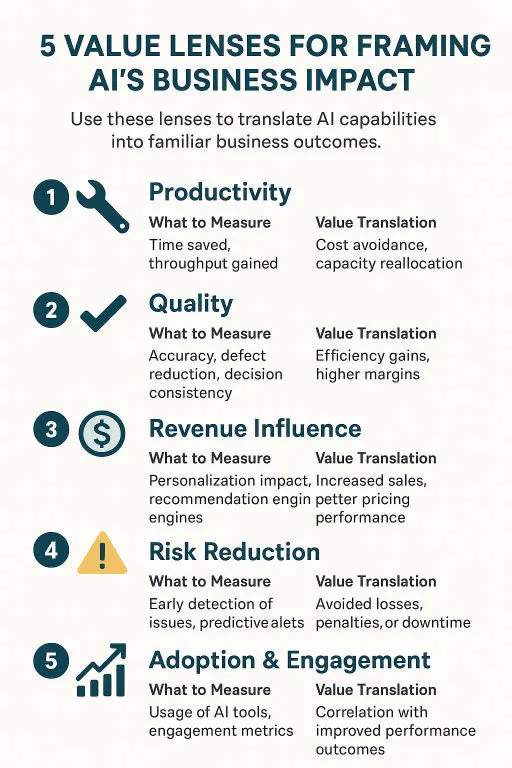
Justifying AI budgets comes down to clearly linking the project to business outcomes. Rather than positioning the AI initiative as a tech experiment, tie it to strategic goals like increasing productivity, reducing waste, or improving efficiency. Using specifi c KPIs such as increased conversion rates or cost savings from automation make your case more compelling.8
ROI Considerations
Unlike traditional projects with set start and end points, figuring out return on investment (ROI) for AI projects isn't always as straightforward. But it's still important to define what success looks like from the beginning. Consider benefits such as increasing customer satisfaction, improving accuracy or quality, or reducing costs. Even qualitative wins—like faster decision making, or stronger compliance—matter too.
Keep in mind that time to value can vary Source: CIO.com9 depending on the project. Some simpler implementations might see ROI in a matter of weeks, whereas more complex projects could take much longer. The key is to set clear milestones so you can track progress.10
Change Management and Implementation
Change management is a commonly overlooked area when it comes to any digital transformation. For companies implementing AI, the shift in how people work can be met with resistance. To manage change within the organization, the first step is a clear communication plan. Employees need to understand why the change is occurring, how it will affect their day-to-day responsibilities and what benefits it will bring. Framing AI as a helpful tool rather than a replacement for human capabilities is an important step for building trust and reducing fear. 7
Change Management, continued...
Communication shouldn't be a one-time event. Engaging employees early and often help secure buy-in and smooth the transition. Involving teams in the design and testing of the AI systems encourages ownership and helps ensure that the systems meet the teams' needs. Ongoing education and a focus on continuous improvement keep the momentum going.11
Wrapping It Up: Strategy First, Tech Second
AI isn't just a buzzword; it's changing the way companies do business. But getting the most value from it requires a carefully thought-out strategy, not just the latest tools. Connecting an AI project to concrete business goals, supported by data, infrastructure and people makes all the difference.
The companies that will win with AI are the ones that prepare, experiment and learn while keeping the focus on what matters to the business. Building AI programs with intention, involving people in the process, have the best chance of success.

About Ultra Consultants
Ultra Consultants helps organizations prepare for the successful integration of artificial intelligence by aligning people, processes, and technology for maximum impact. Our AI Readiness services guide you through every step of your AI journey.
Ultra works with your team to evaluate and select the right AI tools based on your unique business goals and data environment. We help you develop a comprehensive AI implementation strategy, ensuring that your AI initiatives are aligned with operational priorities and long-term growth. To help you gain traction quickly, we also identify high-value pilot opportunities that demonstrate results through fast, measurable wins.
Whether you're just starting out or looking to scale, Ultra's experienced consultants provide the strategic insight and hands-on support to make AI a practical and profitable reality.
Get started with Ultra's AI Readiness services today. Visit ultraconsultants.com to learn more and connect with our team..
References
- Harroch, D and Harroch, R. 15 Quotes on the Future of AI. (2025).
https://time.com/partner-article/7279245/15-quotes-on-the-future-of-ai/
- Aldoseri, A; Al-Khalifa, K; Hamouda, A. Methodological Approach to Assessing the Current State of Organizations
for AI-Based Digital Transformation. (2024). https://www.mdpi.com/2571-5577/7/1/14
- Without data literacy, there is no ROI from data and AI.
https://www.ibm.com/think/insights/data-differentiator/data-literacy-culture
- Lyons-Cunha, J. What Is AI Infrastructure? (2024). https://builtin.com/artificial-intelligence/ai-infrastructure
- Marr, B. The Importance Of Data Literacy And Data Storytelling. (2022).
https://www.forbes.com/sites/bernardmarr/2022/09/28/the-importance-of-data-literacy-and-data-storytelling/
- Morgan, L. What Data Literacy Looks Like in 2025 (2025).
https://www.informationweek.com/data-management/what-data-literacy-looks-like-in-2025
- Acharya, N. How IT Can Show Business Value from GenAI Investments. (2024).
https://www.informationweek.com/machine-learning-ai/how-it-can-show-business-value-from-genai-investments
- Goswami, R. Justifying AI Budgets: A Strategic Framework for Today's CTOs. (2025).
https://ctomagazine.com/justify-ai-budgets-to-the-board/
- Colisto, N. AI is not a special budget category. (2025).
https://www.cio.com/article/4071641/ai-is-not-a-special-budget-category.html
- Walsh, K. What Are The ROI Metrics For AI Projects? (2024).
https://www.forbes.com/sites/cognitiveworld/2024/04/12/what-are-the-roi-metrics-for-ai-projects/
- Ode, J. The Importance of Change Management in the Age of AI. (2025).
https://projectmanagement.ie/blog/the-importance-of-change-management-in-the-age-of-ai/